
Cookie Consent Rates: What's Normal and How to Improve Yours Without Dark Patterns
Analysis of consent rate benchmarks (average 31%, range 4-85%) and ethical optimization strategies. Covers A/B testing approaches, value communication, banner design best practices, and why consented users convert 2-5x better. Takes a strong stance against dark patterns while showing legitimate ways to improve opt-in rates.
Your cookie consent rate sits at 25%. Your competitor claims 70%. Should you panic? Copy their tactics?
Here's the uncomfortable truth: that 70% number might be a liability, not an achievement. And your "low" 25%? It might be perfectly healthy—or it might signal a fixable problem with your banner design, not your ethics.
Cookie consent rates are one of the most misunderstood metrics in digital marketing. Companies chase vanity numbers through manipulative design while regulators hand out nine-figure fines for exactly those tactics. Meanwhile, the "industry average" gets thrown around without the context that makes it meaningful.
This analysis breaks down what consent rates actually mean, what "normal" looks like across contexts, and how to ethically improve your numbers without crossing the legal lines that just cost Google and SHEIN €475 million in September 2025.
TL;DR
- Average consent rates range from 31% to 56% depending on region, industry, and banner design
- Wide variation is normal: legitimate rates span 4% to 85% based on audience and traffic source
- Consented users convert 2-5x better than non-consented users—quality beats quantity
- Dark patterns are explicitly illegal in the EU, with €475M+ in cookie fines in September 2025 alone
- Ethical optimization works: clarity, trust, and value communication improve rates without legal risk
How Consent Rates Became Everyone's Problem
Before GDPR, most websites used implied consent: you visit, we track. The consent rate question didn't exist because nobody was asking.
Then came the regulation—and with it, a new metric that marketers immediately tried to game.
The first generation of cookie banners were compliance theater: massive "Accept All" buttons with tiny "Manage Preferences" links buried in footer text. Consent rates hit 80-90%, everyone celebrated, and data protection authorities started taking notes.
The crackdown came gradually, then suddenly. Here's the timeline:
- 2018-2019: 60-90% clicked "Accept all"—often because there was no real alternative
- 2021-2023: Rejection rates climbed to 40-50% as "Reject All" buttons became visible
- 2024-2025: Half to two-thirds of users now reject when given a genuine choice
The share of websites with equally visible "Accept" and "Reject" buttons increased from 27% in 2023 to 52% in 2025. Consent rates dropped accordingly—not because users became more privacy-conscious, but because they finally had a real choice.
What's Actually Normal? The Benchmark Data
"Average consent rate" is meaningless without context. Here's what the numbers actually look like.
Consent Rates by Region
| Region | Typical Rate |
|---|---|
| Finland | ~66% |
| Poland | ~64% |
| Europe (overall) | ~56% |
| Germany | 40-54% |
| France | ~28-37% |
| United States | ~32% |
| Italy | ~27% |
The variation is striking. German and French users reject cookies most frequently, while Finnish and Polish users accept more readily. If your site serves primarily German traffic, a 40% consent rate might be excellent. The same rate for Finnish traffic would signal a problem.
Consent Rates by Industry
| Industry | Consent Rate |
|---|---|
| Healthcare | 67% |
| Banking/Insurance | Above average |
| Real Estate | Below average |
| Energy | Below average |
| Ad Tech | 23% |
Healthcare's high rate makes sense—users visiting medical sites often have immediate needs and trust the context. Ad tech's dismal 23% reflects well-justified skepticism about how advertising companies handle data. Your industry baseline matters more than you think.
The Dark Pattern Gap
This is where it gets uncomfortable:
| Banner Design | Typical Rate |
|---|---|
| Dark patterns (nudge tactics) | Up to 90% |
| Compliant with visible reject | 40-50% |
| Equal prominence accept/reject | 30-40% |
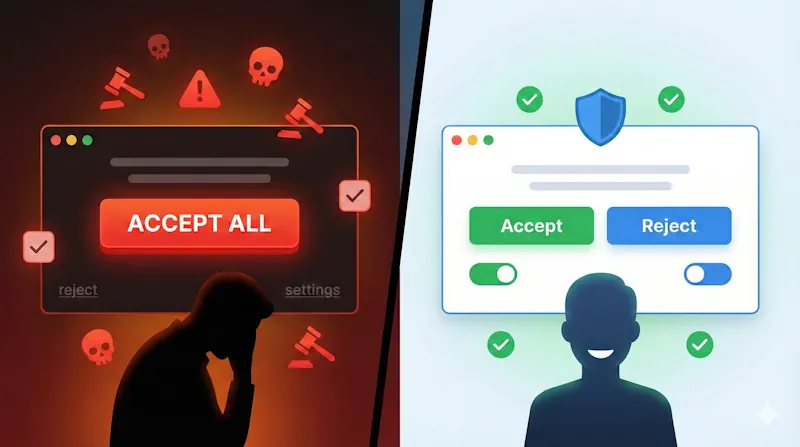
The gap between manipulative and compliant design is 40-50 percentage points. That's not "optimization"—that's the difference between asking for consent and coercing it.
Traffic Source Matters More Than You Think
User intent dramatically affects consent behavior:
- DuckDuckGo referrals: Much higher rejection rates (privacy-conscious users)
- Facebook/Google ads: Significantly higher acceptance (users comfortable with tracking)
- Direct traffic: Middle ground
Your traffic mix influences your baseline more than most banner optimizations ever will. Benchmark against your own sources, not industry averages.
Why Consent Quality Beats Consent Quantity
Here's the number that should reframe your entire approach:
Consented users convert 2-5x better than non-consented users.
This isn't correlation—it's causation in both directions.
Users who consent are more engaged. They're not in "bounce quickly" mode. They're considering a purchase, reading content carefully, or actively interested in your offering.
Consent enables personalization that drives sales. Retargeting, abandoned cart emails, and personalized recommendations all require consent. These are proven conversion drivers.
The math changes everything. If 50% of users consent but convert at 3x the rate, your 50% consent rate captures far more than 50% of potential revenue.
One case study showed a 50% consent rate resulting in only a 19% drop in conversions—because the non-consenting users weren't going to convert anyway.
This is why chasing 90% consent rates through manipulation is strategically foolish, not just ethically problematic. You're not capturing more buyers—you're polluting your data with users who will never purchase and now actively distrust you.
Dark Patterns: The €475 Million Warning
If ethical arguments don't move you, financial ones should.
The September 2025 Reckoning
September 2025 was the most consequential month for cookie enforcement in history:
| Company | Fine | Violation |
|---|---|---|
| €325M | Consent designs that "steered users toward personalized ads" | |
| SHEIN | €150M | Cookies before consent; broken "Reject all" button |
| Total | €475M+ | In cookie-related fines in one month |
These weren't edge cases. The violations are shockingly common:
- Asymmetric buttons: Bold "Accept" with faded "Reject"
- Extra clicks to refuse: One click to accept, multiple clicks to reject
- Pre-consent tracking: Cookies firing before banner interaction
- Consent walls: Blocking content until users accept
- Pre-checked boxes: Default toggles set to "on"
Austria's highest court ruled in 2025 that colored "Accept" buttons with gray "Reject" links violate GDPR. France's CNIL is systematically auditing cookie implementations. AI-powered enforcement tools are now scanning millions of websites automatically.
The era of "everyone does this" as a defense is over.
Ethical Optimization: Six Strategies That Actually Work
You can legitimately improve consent rates without manipulation. Here's how:
1. Communicate Value, Not Legal Requirements
Most cookie banners explain what you're asking for without explaining why users should care.
Instead of: "We use cookies for analytics and marketing purposes."
Try: "Cookies help us remember your preferences and show you relevant products. Your data stays with us—we don't sell it."
Users grant consent when they understand the exchange and trust the recipient. Generic legal language builds neither.
2. Simplify Without Hiding Options
Binary choices (Accept All / Reject All) outperform granular options on the first screen. Only 2-3% of users select specific cookie categories.
This isn't a license to hide options—it's guidance on information architecture:
- First screen: Clear Accept/Reject with equal prominence
- One click away: Granular category controls for users who want them
- Never: Buried settings, multi-page flows, or required interactions
3. Test Banner Position
A/B testing research shows position matters:
- Bottom-left: Most interaction (both accepts and rejects)
- Bottom-right: Highest acceptance rate (~34% on desktop)
- Full-page overlays: Higher acceptance but worse UX—and increasingly scrutinized
DHL's A/B testing found a left-justified banner with full text display earned them a 40% increase in opt-ins. Not through manipulation—through clarity.
4. Match Your Brand Design
Users trust cookie banners that look like part of your site, not intrusive legal popups. Extract your brand colors, use your fonts, match your voice.
Cookient's style extraction feature automates this—but even manual CSS customization pays dividends in user trust and consent rates.
5. Know Your Baseline
If most of your traffic comes from privacy-focused sources (organic search, direct, DuckDuckGo), expect lower consent rates as a baseline.
Running Facebook and Google ads? You'll likely see higher rates—those users have already demonstrated comfort with tracking.
Benchmark against your own traffic sources, not abstract industry averages.
6. Ask Once, Respect the Answer
Studies show repeated nudges increase consent rates. They also increase user annoyance and regulatory scrutiny.
Ask once. If users dismiss without choosing, default to privacy-respecting behavior. Re-prompt only when material terms change—and document the legitimate reason.
The Business Case for Ethical Consent
The counterintuitive conclusion: compliant consent design is better for business.
First-party data relationships are more valuable. Users who actively consent are signaling interest. They're opting in to a relationship, not being tricked into tracking.
Your data quality improves. Coerced consent pollutes analytics with disengaged users. Genuine consent gives you cleaner segments and more meaningful behavioral data.
Your risk exposure drops. The €475 million in September 2025 fines came from practices many companies still use. Every day with manipulative design accumulates regulatory risk.
User trust compounds. Privacy-respecting design signals you take user interests seriously. This is a brand attribute, not just a compliance checkbox.
What You Should Do Next
Audit your current banner. Are accept and reject equally prominent? Does reject work in one click? Are you tracking before consent?
Check your rates in context. Compare against your industry, region, and traffic sources—not abstract averages.
Test ethical changes. Position, timing, copy, and design all influence rates without dark patterns.
Focus on conversion, not consent percentage. A 40% consent rate with engaged users beats an 80% rate with manipulated visitors.
Stay current on enforcement. What was tolerated in 2023 is being fined in 2025.
Conclusion
Cookie consent rates aren't a number to maximize—they're a signal to understand.
A "low" rate with a compliant banner might mean your traffic is privacy-conscious. A "high" rate with a manipulative banner is a regulatory time bomb. The goal isn't the highest possible percentage—it's the highest legitimate rate that reflects genuine user choice.
The good news: ethical optimization works. Clear communication, smart design, and genuine value propositions improve consent rates without legal risk. And the users who consent through honest practices are worth dramatically more than those who clicked through manipulative interfaces.
The businesses succeeding in 2026 treat consent as part of their value proposition rather than an obstacle to game. They're building first-party data strategies on a foundation of trust, not dark patterns.
Your consent rate isn't too low. Your competitor's might just be illegally high.
Need a consent management platform that prioritizes compliance without sacrificing conversion? Cookient's ~5KB script won't impact your Core Web Vitals, and our design tools help you build ethical banners that convert. Start your free trial.